
CPAP & BiPAP Therapy
How to Stop CPAP Rainout (Water in Your Hose and Mask)
Nov
Published by Sleep Longevity, the education center of CPAP Store USA. Last updated November 2026.
By the Sleep Longevity Team at CPAP Store USA
Quick answer: CPAP rainout is the condensation that forms when warm, humidified air from your humidifier cools inside the tubing and turns back into water — so you wake to droplets in the hose, a gurgling sound, or a damp face. It is uncomfortable but not dangerous, and it is fixable. The most reliable way to stop CPAP rainout is to narrow the gap between the air temperature in your tube and the temperature of your bedroom: use heated tubing with Climate Control Auto, lower your humidity or tube-temperature setting a notch, warm the room, insulate the hose, and keep the machine below the level of your head so any water drains back toward the chamber instead of your mask.
🛒 Shop heated tubing, humidifiers and CPAP supplies at CPAPStoreUSA.com.
Key takeaways
- CPAP rainout happens when warm, moist air cools in the hose and condenses into liquid water.
- It is a comfort problem, not a safety emergency — keep using your prescribed therapy while you troubleshoot.
- Heated tubing paired with Climate Control Auto is the single most effective fix for most users.
- If you only have a standard humidifier, lower the humidity level and warm the bedroom.
- Keep the machine on the floor or below your mattress so condensation drains back to the chamber, not your face.
- Waking to an empty water chamber usually points to mask leak, not rainout — a different fix.
CPAP rainout, by the numbers
- 60–86°F — the range you can set a ResMed heated tube to in Climate Control Manual mode; lowering it is a primary rainout fix. (ResMed)
- 1–8 — the humidity levels on a ResMed AirSense (default 4); dialing it down reduces the moisture available to condense. (ResMed)
- ~40% — the share of CPAP users who experience dry mouth, the opposite humidity problem — which is why the goal is balance, not simply “less humidity.” (ResMed)
What is CPAP rainout?
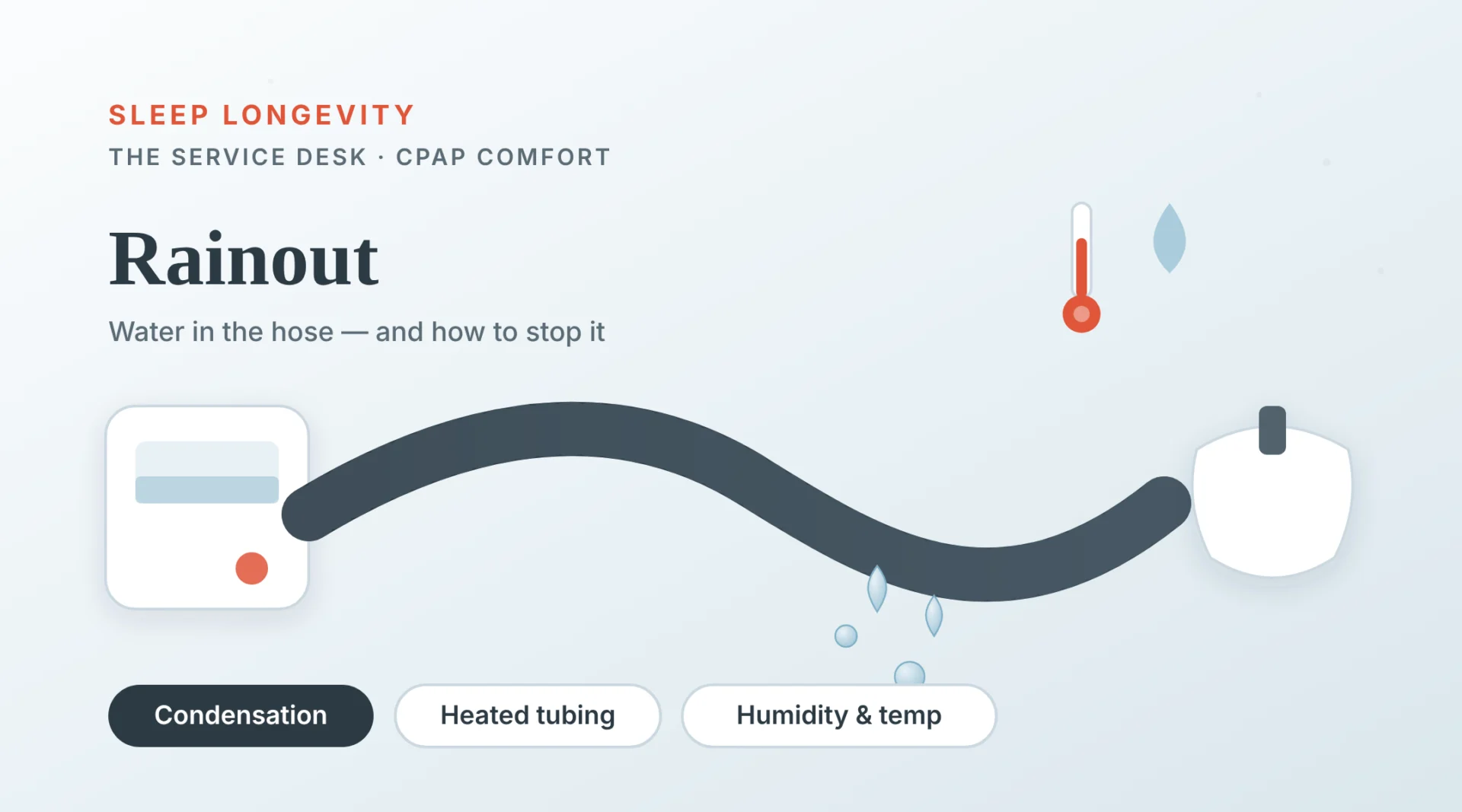
CPAP rainout is condensation inside your CPAP hose and mask. Your humidifier warms and moistens the air so therapy feels more comfortable and your nose and throat do not dry out. As that warm, humidified air travels down the tube toward your mask, it passes through a cooler bedroom. When warm, moisture-laden air meets a cooler surface, it can no longer hold all that water vapor, and the excess condenses into liquid — the same reason a cold glass “sweats” on a summer day. The result is water pooling in the tubing, a gurgling or spitting sound, or a splash of water on your face that can jolt you awake.
Why does water collect in my CPAP hose?
Rainout comes down to a temperature gap. The bigger the difference between the warm air inside your tube and the cool air in your room, the more condensation you get. Common triggers include:
- A cold bedroom — winter nights, air conditioning, or a fan blowing across the hose all cool the air inside it.
- A humidity setting that is too high for your room, so there is simply more moisture available to condense.
- Standard (non-heated) tubing, which lets the air lose its warmth before it reaches your mask.
- The machine sitting higher than your head, so gravity carries any condensation down the hose toward your face instead of back to the chamber.
How do I stop CPAP rainout? (step by step)
- Lower your humidity by one level and give it a few nights. On a ResMed AirSense, humidity runs from 1 to 8 (default 4). Small, gradual changes let you find the point where the air is still comfortable but no longer “raining.”
- Turn on Climate Control Auto if you have heated tubing. ResMed’s Climate Control Auto continuously monitors the air in your mask and adjusts the humidifier and tube temperature together to hold a steady comfort level — ResMed describes it as the best protection against rainout for most users.
- If you use Manual mode, lower the tube temperature a notch. Heated tubes are adjustable from 60–86°F (the AirSense 10 default is 81°F). A slightly cooler tube temperature often clears rainout; drop it 1–2 degrees at a time.
- Warm the room or move cold air sources. Raising the bedroom temperature, or simply pointing a fan or AC vent away from the hose, shrinks the temperature gap that causes condensation.
- Insulate the hose. A fleece tube wrap or hose cover keeps the air inside warm as it travels — especially helpful in a cold room if you do not have heated tubing.
- Keep the machine below your head. Place it on the floor or a low nightstand so any water that does form drains back down to the humidifier chamber rather than up into your mask.
- Add heated tubing if you do not have it. Because rainout is caused by air cooling in the tube, a heated tube (such as ResMed’s ClimateLineAir) is the most direct hardware fix.
What humidity and tube-temperature settings should I use?
There is no single “correct” number — the right setting depends on your room and how your airway feels. Climate Control Auto handles this automatically on compatible machines. If you prefer Manual mode, here are the ranges and factory defaults ResMed publishes, as a starting point to adjust from:
| Setting | ResMed AirSense/Air10 | ResMed S9 |
|---|---|---|
| Humidity level | 1–8 (default 4) | 1–6 (default 3) |
| Heated tube temperature | 60–86°F (default 81°F) | 60–86°F (default 80°F) |
| To reduce rainout | Lower humidity and/or tube temperature one step at a time; warm the room | |
| To reduce dryness | Raise humidity first; if still dry, raise tube temperature 1–2°F | |
Heated tubing is required to change the tube temperature. If you make changes on a prescribed machine, loop in your doctor or equipment supplier — they can also turn on Manual mode if it is locked.
Is CPAP rainout dangerous?
No. Rainout is water condensing in the tubing, not water being pushed into your lungs — your CPAP cannot “drown” you. The real cost is comfort and consistency: a wet face, gurgling, and interrupted sleep can make people dread the mask and use therapy less, which is the outcome that actually matters for your health. That is why solving rainout is worth the few nights of fine-tuning. Keep using CPAP as prescribed; it remains the first-line treatment for moderate-to-severe obstructive sleep apnea.
Rainout or mask leak?
These two problems feel different and have different fixes. Rainout leaves water in the hose and mask while the chamber still has water in it. If instead you wake up and the humidifier chamber is empty, that usually means air (and moisture) is escaping through a mask leak before it reaches you — see our guide on how to fix CPAP mask leaks. And if your issue is a dry mouth or nose rather than a damp face, that is the low-humidity side of the same dial — our guide on how to stop dry mouth from CPAP walks through it.
Frequently asked questions
Why does my CPAP hose fill with water only in winter?
Colder bedrooms widen the gap between the warm air in your tube and the room, so more moisture condenses. In winter, lower your humidity a notch, warm the room if you can, and insulate the hose or switch to heated tubing.
Will a heated CPAP hose completely stop rainout?
For most people it dramatically reduces or eliminates it, because it keeps the air warm all the way to the mask. In a very cold room you may still need to pair it with a lower humidity setting or Climate Control Auto, and a tube wrap can help further.
Can I just turn the humidifier off to stop rainout?
You can, but it often trades one problem for another: with no added moisture many users get dry mouth, a sore throat, or nasal congestion. Lowering the humidity a step or two — rather than shutting it off — usually stops rainout while keeping your airway comfortable.
Should the CPAP machine be above or below the bed?
Below. Keep it on the floor or a low surface so condensation drains back down toward the water chamber instead of running up the hose to your mask.
Is the water in my hose unsafe to breathe?
The condensation is from your humidifier’s distilled water and is not harmful, but it is uncomfortable and can disrupt sleep. Empty and dry the tubing in the morning and clean your equipment regularly — see our guide on how to clean your CPAP machine, mask, and tubing.
Medical disclaimer: This article is general education, not medical advice. CPAP settings are part of a prescribed therapy — make changes to pressure, humidity, or tubing in partnership with your doctor or equipment supplier.
Sources: ResMed, “Avoid CPAP rainout” and “Manual mode: Know your CPAP humidifier” (settings ranges, defaults, Climate Control Auto, dry-mouth figure); ResMed ClimateLineAir product information (heated tubing); general sleep-medicine guidance on humidification and CPAP comfort.
🛒 Shop CPAP machines, masks & supplies at CPAPStoreUSA.com — free 2-day shipping on most orders, and HSA/FSA accepted.
✍️ About this guide — Brought to you by Sleep Longevity, the education center of CPAP Store USA, where we translate the science of better sleep into practical steps you can use tonight. — The Sleep Longevity Team at CPAP Store USA.
